We are committed to providing quality service to residents located In the Buford, GA area. Our website has additional information about the following topics: Dentist, Cosmetic Dentist, Family Dentist, Botox, Dental Implants, Dental Crowns, Dental Bridges, Veneers, Invisalign Dentist and Oral Surgery.
Patient Review Video of Dr. Ashley Curington
Dr. Ashley & Crew provide great dental care in an upbeat atmosphere. Appointments are thorough yet expedited so no one's time is wasted. Dr. Ashley stays up to date with dental applications and now offers testing for oral cancer. So, a lot is covered at this practice - teeth, overall health and beauty.
Think Stress doesn't manifest symptoms in your mouth? Think again! Most people don't realize that stress not only affects your blood pressure, but can have lasting effects on your teeth and gums.
How can the dentist help during stressful times?

I was reading a new study about a link between gum disease and Alzheimer’s. We often treat periodontitis or gum disease in our patients. It is common in older people and may become more common in Alzheimer’s disease because of a reduced ability to take care of oral hygiene as the disease progresses. When you have higher levels of antibodies to periodontal bacteria the study found an associated increase in levels of inflammatory molecules elsewhere in the body, which in turn has been linked to greater rates of cognitive decline in Alzheimer’s disease in previous studies.
This latest study set out to determine whether periodontitis or gum disease is associated with increased dementia severity and subsequent greater progression of cognitive decline in people with Alzheimer’s disease. The study revealed that the presence of gum disease at baseline was associated with a six-fold increase in the rate of cognitive decline in participants over the six-month follow-up period of the study. Periodontitis at baseline was also associated with a relative increase in the pro-inflammatory state over the six-month follow-up period. The authors conclude that gum disease is associated with an increase in cognitive decline in Alzheimer’s disease, possibly via mechanisms linked to the body’s inflammatory response.
More and more studies link the body’s inflammatory response to increased rates of cognitive decline, suggesting that we should explore whether the treatment of gum disease might also benefit the treatment of dementia and Alzheimer’s disease. Professor Clive Holmes, senior author from the University of Southampton, says: “These are very interesting results which build on previous work we have done that shows that chronic inflammatory conditions have a detrimental effect on disease progression in people with Alzheimer’s disease. Our study was small and lasted for six months so further trials need to be carried out to develop these results. However, if there is a direct relationship between periodontitis and cognitive decline, as this current study suggests, then treatment of gum disease might be a possible treatment option for Alzheimer’s.”
Dr. Mark Ide, says: “A number of studies have shown that having few teeth, possibly as a consequence of earlier gum disease, is associated with a greater risk of developing dementia. We also believe, based on various research findings, that the presence of teeth with active gum disease results in higher body-wide levels of the sorts of inflammatory molecules which have also been associated with an elevated risk of other outcomes such as cognitive decline or cardiovascular disease. Research has suggested that effective gum treatment can reduce the levels of these molecules closer to that seen in a healthy state.
The full study, "Periodontitis and cognitive decline in Alzheimer's disease," was published here http://journals.plos.org/plosone/article?id=10.1371/journal.pone.0151081
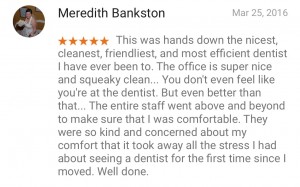
It means so much to me as a practice owner that our patients actually take the time to give us a 5 star dental reviews. Not only is constructive feedback useful for shaping our delivery of service, but positive feedback really makes our staff smile! They all work really hard, and I ask a lot from them to be sure that patient care is at the center of our dental practice. I have recently found out how important these “reviews” are online. When I first started practice, the yellow pages or a neighbor were the primary ways new patients found our practice. Today most everyone goes to Google or Yelp.
• 90% of people only look at the 1st page of Google results
• 80% of consumers research products online every week. (oracle.com)
• 70% of people trust the opinions of other consumers posted online. (nielsen.com)
• The average consumer consults 11 online reviews before making a purchasing decision. (Source: socialbarrel.com)
• Consumer reviews are 12 times more trusted than product descriptions. (Source: socialbarrel.com)
So taking the time to give us feedback means so very much to our practice. They say that prominently displayed negative reviews on a review site are enough to make people pass on what you’re offering. Too often people use the review sites when they are angry or upset. So, a VERY BIG THANK YOU to all of our patients who take the time to write a positive review for our practice. I am sure Meredith read what one of you posted before she visited our office.
Mad love ~ Ash
Without question over the last two decades dental implants have revolutionized tooth replacement and the practice of dentistry. The concept of dental implants is not new, the earliest recorded attempts of their use were discovered in the Mayan civilization dating back to 600 A.D. Today's highly successful dental implants consist of root replacement for a natural tooth, to which a crown is attached, just like the teeth in your mouth when you smile, there is no visible difference. In addition they do not decay and are relatively free from developing gum disease. As with most treatment modalities in dentistry today, this not only involves scientific discovery, research and understanding, but application in clinical practice. The practice of implant dentistry requires expertise in planning, surgical placement and crown fabrication; it is as much about art and experience as it is about science. It also requires teamwork between you, the patient, and our dental team.
The video shows the assembly necessary to restore an implant with a crown. The assembly consists of an abutment with a screw that fits into the implant and a permanent crown, which is then cemented onto the abutment.
Teeth essentially can be thought of as having two main parts, the crown, the part above the gum tissues, and the root, the part that is suspended in the bone by the periodontal ligament (peri-around, odont-tooth) that keeps the tooth in place. A dental or endosseous implant (endo – inside, osseous – bone) is actually a root replacement, but unlike the root of a tooth it becomes anchored in the bone of the jaw, formerly occupied by a tooth or teeth.
The amazing thing about currently used dental implants is that they actually fuse with, or “integrate” into the bone, a process known as “osseo-integration” (osseo-bone, integrate – to become part of). They are for the most part made of commercially pure titanium, a metallic substance used for many years in medicine and dentistry because it is not rejected by the body, being osteophilic (bone loving). The actual process of osseo-integration is essentially a biochemical fusion of living bone cells and bone substance to an oxide layer that forms on the surface of the titanium.
Call our office today to see if dental implants are right for you. 770-932-1115
No it is not money, or fame. It is going to the dentist according to a research director from the Gallup-Healthways Well-Being Index. I agree that this is an unintuitive characteristic and a visit to the dentist will, of course, not fix all of your problems, but places where people have good dental health also tend to be places where they report being generally fulfilled.
“It’s a surrogate for it,” Witters said. “People who take good care of their teeth generally think they have higher well-being lives.”
I am so happy to see this. Proper oral care can keep you smiling well into retirement. Let's face it, regular dentist visits can do more than keep your smile attractive – they can tell a lot about your overall health, including whether or not you may be developing a disease like diabetes.
New research suggests that the health of your mouth mirrors the condition of your body as a whole. For example, when your mouth is healthy, chances are your overall health is good, too. On the other hand, if you have poor oral health, you may have other health problems. Research also shows that good oral health may actually prevent certain diseases from occurring. You are not hearing this for the first time if you have spent any time in my office.
According to the Academy of General Dentistry, there is a relationship between gum (periodontal) disease and health complications such as a stroke and heart disease. Women with gum disease also show higher incidences of pre-term, low birth-weight babies.
Other research shows that more than 90 percent of all systemic diseases (diseases involving many organs or the whole body) have oral manifestations, including swollen gums, mouth ulcers, dry mouth and excessive gum problems. Such diseases include; Diabetes, Leukemia, Oral cancer, Pancreatic cancer, Heart disease and Kidney disease. So be sure to stay on track with your dental office visits!
You can read more about these fulfilled Americans here
By Ashley P. Curington, DMD – North Atlanta Center for Cosmetic & Implant Dentistry, PC on Botox use

A: Botox® is a toxin derived from a bacterium, Clostridium botulinum. The clinical usage is based on its ability to weaken the muscles where it is injected.
A: Botox® has been used for 30 years for treating medical conditions. It started with ophthalmologists in treating strabismus, and then spread to urologists and finally neurologists. In 2013, the Georgia Board of Dentistry began licensing dentists to use this substance. It has become the gold standard for the treatment of chronic migraines and TMJ. It can also be used to treat facial wrinkling for improved cosmetic appearance.
A: Botox is one of the most effective treatments for certain cosmetic conditions. The key is the correct diagnosis, and recruitment of the right patients for treatment. Variations in medication and the duration of effects can be seen based on the site and dosage of injections. The beneficial effect can be seen within a few days of injections, and the effects last anywhere from 10 to 14 weeks. Treatment needs to be repeated every 12 to 16 weeks on average. As with any other treatment modalities, the beneficial effects vary in patients, and their unique medical conditions.
A: Located on both sides of the head at the point where the jawbone meets the skull, the temporo-mandibular joint (TMJ) is used during talking, eating, swallowing, and other everyday activities. If this joint becomes displaced or is overworked through excessive teeth grinding, a person may suffer severe tension headaches, as well as sharp pain in the jaw. BOTOX® relieves jaw tension by making muscles unable to engage in the powerful, often unconscious movement of the jaw that produces headaches and pain.
The BOTOX® alternative treatment for TMJ disorders and jaw tension is usually quick, straightforward, and effective. A non-surgical procedure, BOTOX® injections are administered in a doctor’s office and treatment requires no hospital stay. Most patients experience noticeable improvement within one or two days of their first treatment, although relief can take up to a week.
A: A good source for information is the American Academy of Facial Esthetics.

Studies show that nearly 40 percent of Americans skip some dental care and almost 80 percent will feel something wrong in their mouths and ignore it when possible.
In fact, an estimated 150 million American adults avoided a dental visit altogether last year.
A Federal Reserve survey found a quarter of respondents delayed getting dental care for financial reasons. Another recent survey found that nearly two in five American adults say they either delay dental care or have limited dental work done due to their financial situation. That number has increased by nearly 8 percent in the past two years.
About 80 percent of patients are even aware that postponing or delaying routine visits will cost them more money in the long run.
“The longer you wait, the more costly it becomes,” is all too true. As a Dentist, I have heard all sorts of excuses, including “I treat teeth like transmissions, if it works, leave it alone”, and unfortunately, nearly one in five Americans say they would fix problems with their car ahead of taking care of their teeth. That is a strategy that causes lost teeth and costly replacement options.
If you have waited too long to address your dental concerns and you don't win the lottery, you may like to know about the many financing options, including no interest plans, using Care Credit. We offer it in our practice so ask us for more information. Good Luck tonight!
Spring is a time to reevaluate your daily routine and reduce any unnecessary clutter from your life. It is also a time to make positive changes for a happy and healthier lifestyle. Here are a few tips from Dr. Curington:
With these small changes to your lifestyle, you can upgrade your health for a better you.
